 Illustration of the evolution of human learning environments
Left: “primitive” learning completely immersed in the natural and social environment
Middle: the contemporary institutionalised learning environment more often then not contained in a box
Right: The diversification of creative learning environments of the future
Illustration of the evolution of human learning environments
Left: “primitive” learning completely immersed in the natural and social environment
Middle: the contemporary institutionalised learning environment more often then not contained in a box
Right: The diversification of creative learning environments of the future
Creative Learning Environment Background
a new approach towards (institutional) learning
Learning was once a truly universal experience. Immersed in an environment beyond full comprehension, humans employed all their senses to make sense of the world around them.
This deep engagement with the environment—combined with a creative impulse, arguably the most powerful of all human capacities—formed the foundation for the remarkable evolution of mankind.
What is now often referred to as immersive learning was, in fact, the natural and dominant mode of learning throughout most of human history. This changed with the Industrial Revolution and the emergence of the nation-state, which demanded more rationalized and controllable forms of learning—and placed them into a box, or what we now call “school”.
Our mission is to develop and share concepts that recognize learning as an inherently creative process, and to move both learning and the learner out of the box and back into rich, dynamic social and natural environments.
a new approach towards (institutional) learning
Learning was once a truly universal experience. Immersed in an environment beyond full comprehension, humans employed all their senses to make sense of the world around them.
This deep engagement with the environment—combined with a creative impulse, arguably the most powerful of all human capacities—formed the foundation for the remarkable evolution of mankind.
What is now often referred to as immersive learning was, in fact, the natural and dominant mode of learning throughout most of human history. This changed with the Industrial Revolution and the emergence of the nation-state, which demanded more rationalized and controllable forms of learning—and placed them into a box, or what we now call “school”.
Our mission is to develop and share concepts that recognize learning as an inherently creative process, and to move both learning and the learner out of the box and back into rich, dynamic social and natural environments.
Creative Learning Environment (CLE) overview
Learning is not defined by manuals or curricula, but by fields of activity
Institutionalised learning is more often than not overwhelmingly defined by a curriculum. For a variety of reasons - that often have more to do with management and accountabilty than with the quality of learning - we have settled on the curriculum as the main conveyor of learning content and this creates a number of profound challenges.
By conveying something so complex and multifaceteded like human learning in a written “manual” we are radically limiting the experience of the learner. While there is a lot of content conveyable via a written manual, there are clear limits especially in regard to developing creativity and hands on experience with multidemensional tasks embedded in complex environments.
At the beginning of the 21st Century, in what often is refered to as the “Anthropocene”, we more and more understand that it is not knowledge or prescribed methodology that helps us face a new category of human-induced problems, but that we have to support the development of new forms of sensibility and conscousness towards our environment. The ability to sense complex problems, even before science has collected any data, and experience with going about complex tasks with creativity will be core educational goals of coming generations and we increasingly understand that the current kowledge focussed static educational system is not well prepared to face such requirements.
In our research we focus on defining learning not by a written manual, like a curriculum, but by devising learning environments that give the learner the agency to explore complex and inspiring fields while experiencing at first hand what it means to interact with complex systems.
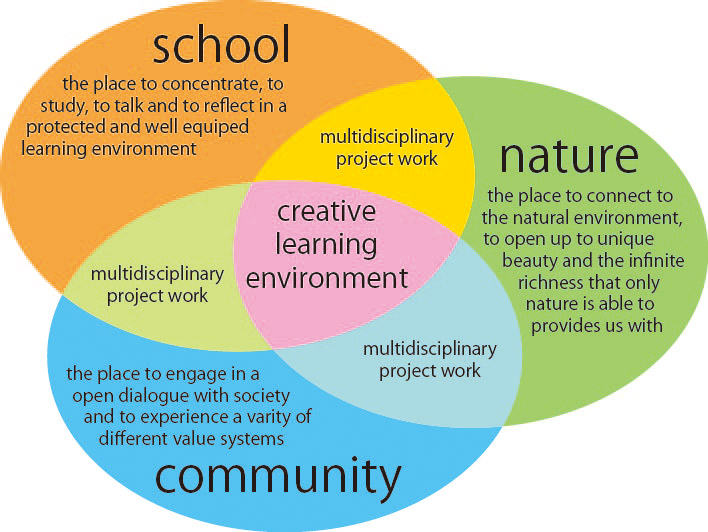
The illustration to the right is a concept schetch of what we consider Creative Learning Environment and it aims at immersing the learner in various learning environments, including local social contexts and nature.
The basic approach of this research has been developed as part of an applied research project that started in 2009 as part of a small alternative school project in Okinawa, Japan.
There’s a visually rich documentation of the various CLE projects and activities from 2014 in english further down on the website.
Learning is not defined by manuals or curricula, but by fields of activity
Institutionalised learning is more often than not overwhelmingly defined by a curriculum. For a variety of reasons - that often have more to do with management and accountabilty than with the quality of learning - we have settled on the curriculum as the main conveyor of learning content and this creates a number of profound challenges.
By conveying something so complex and multifaceteded like human learning in a written “manual” we are radically limiting the experience of the learner. While there is a lot of content conveyable via a written manual, there are clear limits especially in regard to developing creativity and hands on experience with multidemensional tasks embedded in complex environments.
At the beginning of the 21st Century, in what often is refered to as the “Anthropocene”, we more and more understand that it is not knowledge or prescribed methodology that helps us face a new category of human-induced problems, but that we have to support the development of new forms of sensibility and conscousness towards our environment. The ability to sense complex problems, even before science has collected any data, and experience with going about complex tasks with creativity will be core educational goals of coming generations and we increasingly understand that the current kowledge focussed static educational system is not well prepared to face such requirements.
In our research we focus on defining learning not by a written manual, like a curriculum, but by devising learning environments that give the learner the agency to explore complex and inspiring fields while experiencing at first hand what it means to interact with complex systems.
The illustration to the right is a concept schetch of what we consider Creative Learning Environment and it aims at immersing the learner in various learning environments, including local social contexts and nature.
The basic approach of this research has been developed as part of an applied research project that started in 2009 as part of a small alternative school project in Okinawa, Japan.
There’s a visually rich documentation of the various CLE projects and activities from 2014 in english further down on the website.
“Creative Cycle”
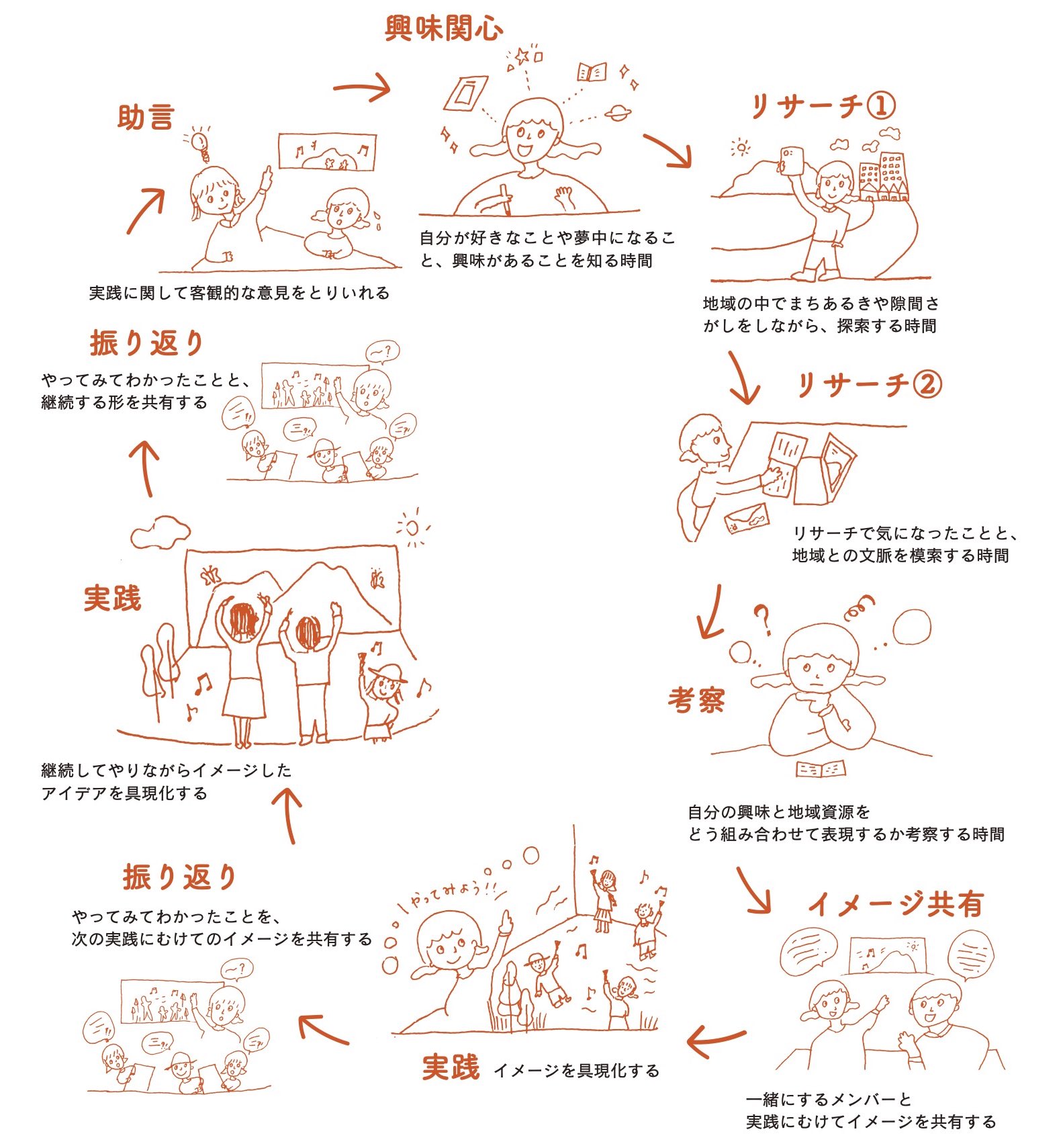
Learning and Creating cycle of CLE
What we might call a “creation cycle” or “creative cycle” is at the core of our reserach activities. It points two closely related activities, one refering to learning as a cycle based on creating, as in creating art works, and another one refering to dialogical process in which the various stakeholders (teachers, students, school principals, stakehilders and members of the local community, experts, advisors, etc.) participate to discuss the development of concrete models for changing the current educational environment to a more open and integrating one. We not aim at changing the school environment from top down, neither do we want to add another layer of learning content or new pedagogic methodologies to an already overflowing and too busy school program.
In the creative cycle we exchange experiences, share information, create collaborational networks, aim at inspiring new ways to look at things, share models, and discuss how to unclutter the current school program to make it more integrated into the social and natural envrionment.
Learning and Creating cycle of CLE
What we might call a “creation cycle” or “creative cycle” is at the core of our reserach activities. It points two closely related activities, one refering to learning as a cycle based on creating, as in creating art works, and another one refering to dialogical process in which the various stakeholders (teachers, students, school principals, stakehilders and members of the local community, experts, advisors, etc.) participate to discuss the development of concrete models for changing the current educational environment to a more open and integrating one. We not aim at changing the school environment from top down, neither do we want to add another layer of learning content or new pedagogic methodologies to an already overflowing and too busy school program.
In the creative cycle we exchange experiences, share information, create collaborational networks, aim at inspiring new ways to look at things, share models, and discuss how to unclutter the current school program to make it more integrated into the social and natural envrionment.
Roles in the Creative Laerning Process
The various actors and their roles in the creative learning enviornment
There are various stakeholders involved in the complex system of institutionalized learning, starting from the students, who should be a the core of any discussion, but often find themselves more like victims of an overarching educational bureaucracy and at the whims of global assessment discussions that increasingly escalate the pressure based on numerical values that only represent a tiny section of human learning achievements with a rigid focus on knowledge and prescribed methodologies.
In our research, we aim at devising an open and dialogical process in which all parties concerned have a say, of course with students and learners at the center.
Another central topic of our research is to develop and test the feasibility of what we call the “Learning Environment Curator”, a new not neseccarily independent role with a focus on facilitating the extension of learning beyond the school premises into the community and the natural environment.
The various actors and their roles in the creative learning enviornment
There are various stakeholders involved in the complex system of institutionalized learning, starting from the students, who should be a the core of any discussion, but often find themselves more like victims of an overarching educational bureaucracy and at the whims of global assessment discussions that increasingly escalate the pressure based on numerical values that only represent a tiny section of human learning achievements with a rigid focus on knowledge and prescribed methodologies.
In our research, we aim at devising an open and dialogical process in which all parties concerned have a say, of course with students and learners at the center.
Another central topic of our research is to develop and test the feasibility of what we call the “Learning Environment Curator”, a new not neseccarily independent role with a focus on facilitating the extension of learning beyond the school premises into the community and the natural environment.

本研究は琉球大学 SDGs 社会課題解決研究プロジェクト経費の助成を受けたものです